
Art Daily Article: Redwood Library presents show on landscape painter and activist, Robert Duncanson
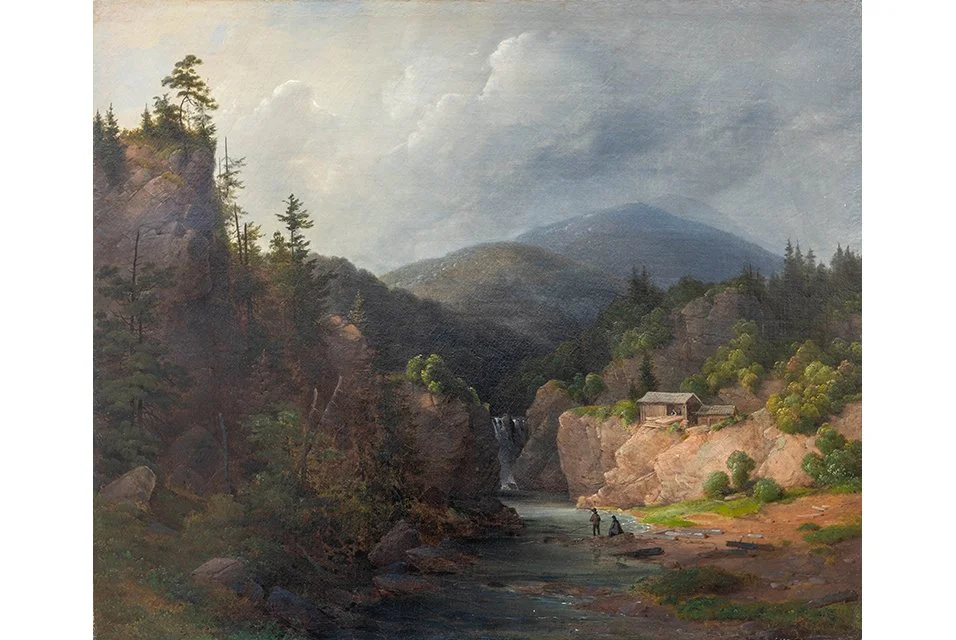
NEWPORT, RI.- The Redwood Library & Athenaeum has opened Robert Duncanson: Landscapes to Freedom, the first exhibition to place Duncanson’s paintings in the context of his involvement in abolitionist politics and the Underground Railroad. On view through January 2027 at the Redwood—the sole venue—the exhibition comprises twenty-eight paintings and numerous site photographs from the collection of Michael Meyer, the acknowledged authority on the artist. The exhibition documents Duncanson’s travels to, and painting of, Southern and Northeastern locations, illuminating the artist’s project of narrativizing a geography of escape nested within the pathways of the Underground Railroad.
Rather than viewing his idyllic forests, rivers, mountains, and pastoral vistas as being outside of politics, Landscapes to Freedom considers them as works deeply embedded within the struggle over slavery and emancipation. Relying on decades of archival research and documentary evidence heretofore unknown to the modern critical literature, the exhibition diverges from past retrospective treatments of the painter’s oeuvre, or of the apprehension of his landscapes as purely painterly achievements, to assert that Duncanson wasn’t just a landscape painter, but also a deeply invested political activist.
Participation in the Underground Railroad demanded absolute secrecy. Assisting freedom seekers could result in imprisonment, violent retaliation, or death. Any visual language capable of supporting that movement therefore had to remain legible to some viewers while appearing innocuous to others. To that end, Duncanson created paintings that depict signal locations along established pathways to freedom to the North and Canada, using iconography and staffage that constitute loaded, racialized narratives that nonetheless remain cloaked in the genre seemingly most distant from politics: landscapes. Hewing to the formulas of Euro-American landscape painting, Duncanson thus concealed an alternative geography: one shaped by movement, concealment, and refuge. As we know, his paintings were dispersed to a constellation of abolitionist collectors, some of whom likely sheltered escaped Southern slaves who would have possibly seen the paintings. Duncanson is in fact the only artist painting slave paths starting from locations in the deep South—such as Caesar’s Head, SC—to Canada.
Duncanson's unusually extensive, and invariably perilous, travels as a Black man through Tennessee, the Carolinas and Virginia after the Fugitive Slave Act of September 1850, and later through New England and the corridor connected by the Grand Trunk Railway, yielded paintings of places that may be understood not only as scenic destinations but also as sites within a broader geography of liberation. Detailed topographies, recognizable landmarks, carefully staged figures, winding roads, river crossings, and forest clearings can be read as elements of a coded visual language that simultaneously described real landscapes and narrated acts of evasion. Instead of illustrating political events directly, the exhibited works obliquely embed political agency within the very fabric of the landscape.
By bringing together these remarkable paintings, Robert Duncanson: Landscapes to Freedom asks us to reconsider the relationship between art and politics in nineteenth-century American landscape painting. Duncanson's landscapes suggest that beauty and resistance were not opposing ideals, but for him inseparable forms of vision. They remind us that, in an era when liberty for Black and Native Americans often depended upon concealment, even the most tranquil landscape could become a map to freedom.
“This exhibition presents the crux of Duncanson’s enterprise, and its thesis and re-readings of the paintings are supported by a wealth of contextual and documentary evidence, and by the paintings themselves, which should be understood as visual documents,” explains Benedict Leca, Executive Director of the Redwood Library & Athenaeum. “There’s a reason why Michael Meyer is the indispensable figure in the study of Duncanson—he’s done the work. No, he doesn’t have a Ph.D., but his eye, his knowledge, and what he has tracked down is astounding: he’s located paintings and studies; trekked through the Appalachian wilds to identify and photograph sites & motifs; sifted through archives to correct long-held inaccuracies, and gathered countless unrecorded mentions of Duncanson in period newspapers that attest to the heretofore omitted Southern chapter of the artist’s career. This is one of the most remarkable stories in American art and Meyer should be recognized for having connected the dots.”